This memo analyzes millions of utterances from lawmakers for their relation to AI, with a focus on Artificial General Intelligence (AGI). We source utterances by officials in the legislative and executive branch of governments and intergovernmental institutions from transcripts of public hearings, letters, speeches, and more. The dataset consists of ~15,000 utterances on AI, drawn from ~200,000 documents put out by 19 governments and intergovernmental organizations.
For the purposes of this analysis, we use version 2.10.0 of our dataset, scraped on September 10th 2026. The utterances were selected for relevance to AI through a keyword filter followed by tagging by an LLM. We only include utterances attributable to an individual public official. See our definitions page regarding what we mean by, for example, artificial general intelligence. Read the full method and explore the data yourself.
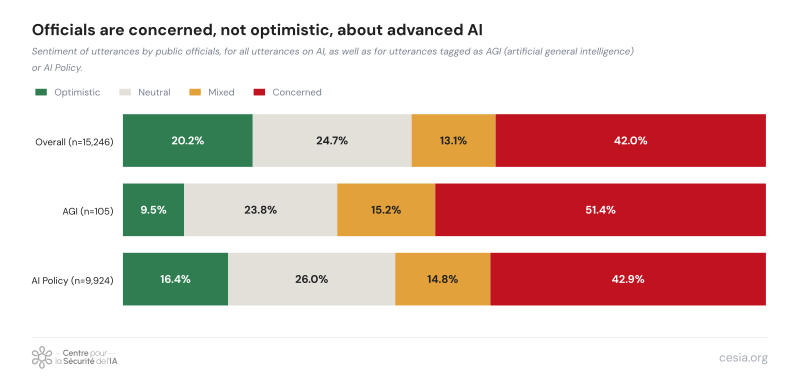
Concern is the most common sentiment about AI in regulatory discussions.
Of all utterances on AI in our dataset, 20% are optimistic, while 40% show concern. Restricting this to utterances on AGI, 10% of utterances are optimistic and 50% show concern. Utterances that dismiss AI risk tend to express worries about regulation that impedes competitiveness.
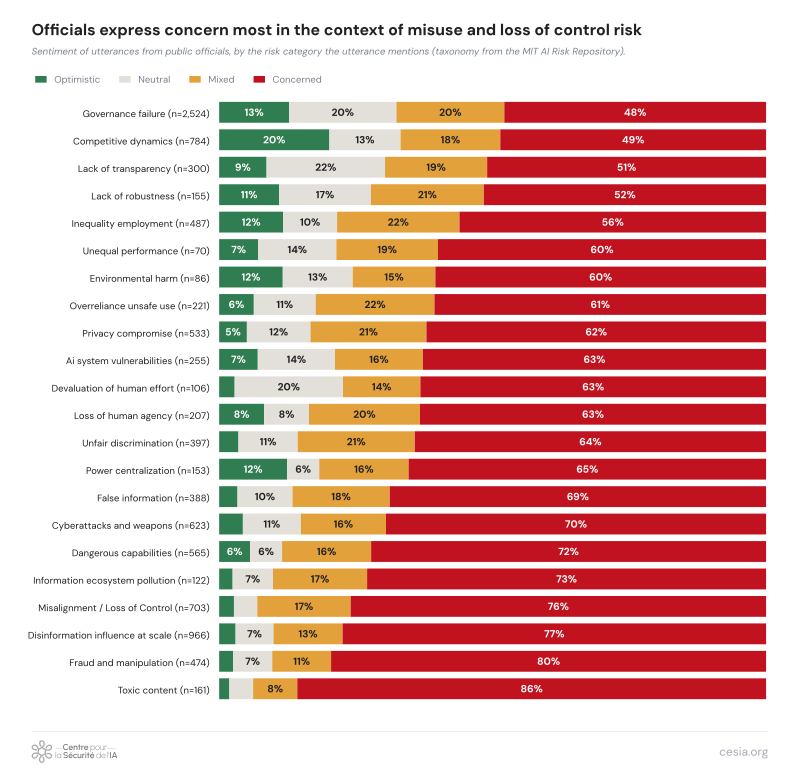
Across jurisdictions analyzed, lawmakers share concerns for humanity losing control over AI.
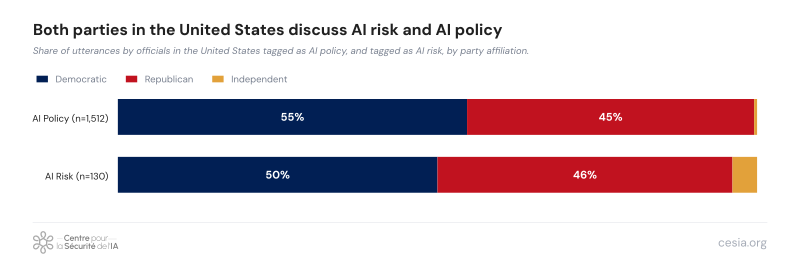
Lawmakers in the United States, China, the European Union, United Kingdom, Japan, and more are on the record for worries about loss of control over AI. Discussion of AGI is represented across the political spectrum in these countries; including in the United States, where both parties discuss AI risk and AI policy in roughly equal volume. The most frequently discussed risks discussed in the context of AGI are loss of control over AI, governance failures, dangerous capabilities of AI, and a reckless race to build AI. A rarely discussed risk is centralization of power due to AI.
“Yesterday, my colleagues and I, we were, in a letter, trying to bring the risk of AI to the attention of other colleagues of ours, we specifically are targeting the potential catastrophic risk associated with the use of AI and the development of biological, chemical, cyber, and nuclear weapons.”
“We also have to think of the second half of this century and whether artificial intelligence becomes a creature with its own volition and its own objectives. [...] We had better make sure that the machines we build do not literally take on a life of their own, create their own objectives and their own tasks, seek to survive and propagate, and seek to achieve their own objectives.”
Solutions discussed are often not proportional to risks discussed.
In utterances that mention misalignment or loss of control risks, the most often discussed governance strategy is “governance development”, that is, the subsequent development of other AI-related governance instruments. We find few mentions of governance strategies that promise a direct reduction of loss of control risks. Single lawmakers have however proposed more ambitious regulation, such as a moratorium on frontier AI development (especially in the UK) and on the construction of new data centers specifically (especially in the US, and Australia). In the risk taxonomy adopted here (the MIT AI Risk Repository Framework), by far the most common categorization is “a gap in governance of AI”.
“I beg to move, that leave be given to bring in a Bill to make provision to prohibit the development, deployment and operation of artificial superintelligence systems; to establish monitoring and control powers in respect of such systems; and for connected purposes.”
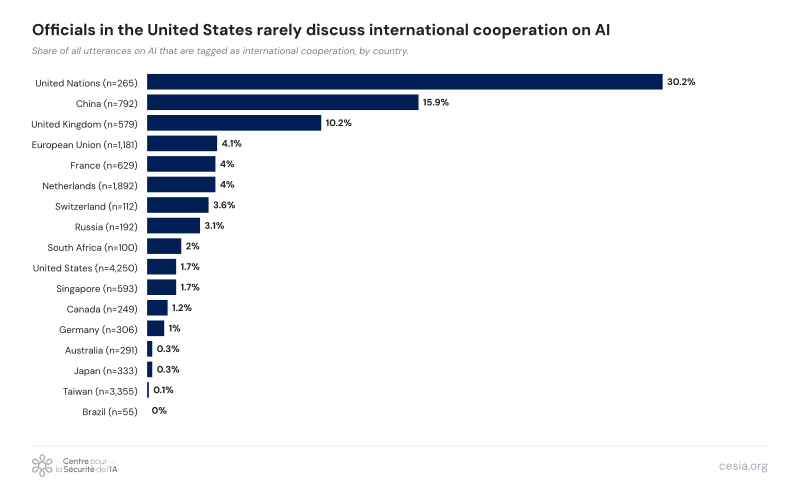
International cooperation on AGI regulation and development is discussed often, but the United States lags behind.
Legislators in the United States, China, European Union, United Kingdom, and Singapore discuss international cooperation on AI.
While the United States would be the most important party in an international agreement, discussion of international agreements mostly comes from elsewhere. The countries with the most mentions of international coordination topics per utterance were China, the United Kingdom, France, and the Netherlands. The United States discuss international cooperation much less often, as do Japan, Taiwan, and Germany. We emphasize that these data only treat discussion, not action.
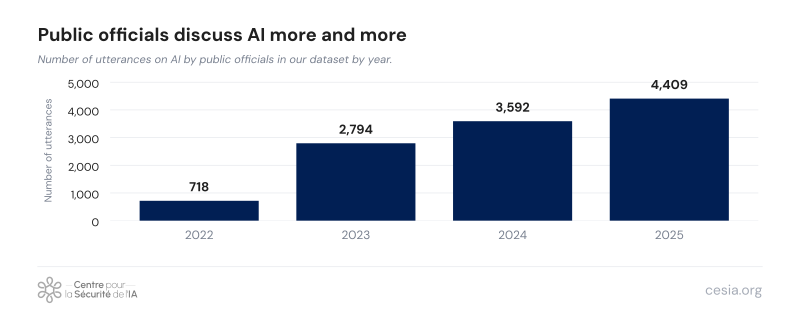
Global discussion of AI is elevated since mid-2023.
Discussion of AI by public officials rose sharply in 2023. While AI capabilities increase exponentially, discussion volume has been increasing only linearly since then. The largest monthly volume so far was in June 2026, a large uptick in part caused by discussion in Europe of the export controls for Anthropic’s Claude Fable.
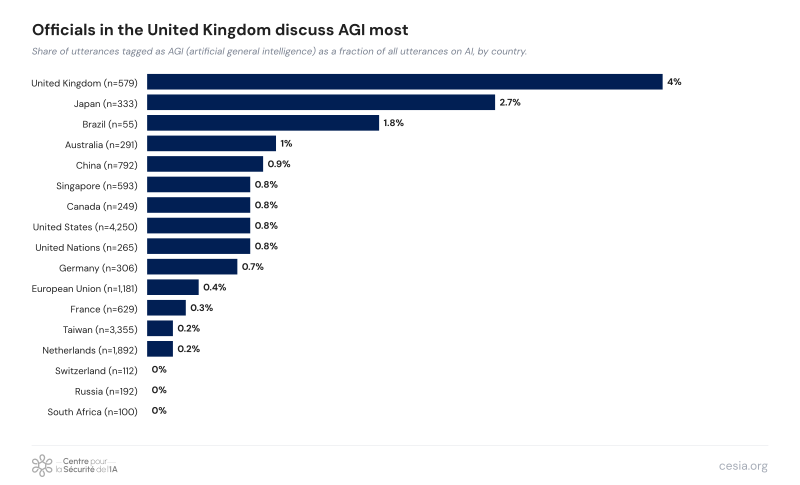
The United Kingdom leads on lawmaker AGI discussion.
The share of AGI-relevant discussion of overall AI discussion is many times higher in the United Kingdom than in the United States and other countries. It has what could be described as the highest state capacity regarding AI risks of any nation, via its AI Security Institute, whose results are regularly cited in policy discussion.
Vocabulary related to AGI differs between countries.
For example, in government discussions in China, it is currently not clear what vocabulary in Chinese would be analogous to “AGI” in English. Some terms that initially sound similar to AGI as used in countries like the US are perhaps more similar to “generally applicable AI”. Recursive self-improvement is sometimes described as “AI for AI”, and so on. In Taiwan, AGI topics are usually discussed using the English “AI” without further qualification. Dutch legislators often use “advanced AI”, while US, Japanese, and British legislators often use “AGI”, “ASI”, “singularity”. In our analysis, we use a tailored keyword list for each of the 11 languages that occur in the dataset.
Potential limitations of our study are subjective tags applied by AI judges and incomplete coverage of government discussion.
We selected sources for the 19 included jurisdictions based on expected volume of AI discussion and ease of obtaining data. It could be that AI discussion happens in sources that we missed, that are not online, or not recorded at all. We hand-annotated a subset of samples and ensured sufficient agreement between human and AI-applied labels, the bulk of the above results nonetheless rely on labels by a majority vote of three annotator LLMs. Since the labels are subjective, we cannot fully rule out that the results are partially due to biases in our process. To mitigate this, we tried different configurations of the process, and only present results that we believe are not artifacts of our process.
We thank Yilin Huang, Otto Barten, Nestor Maslej, Peter Slattery, Jasmine Sun, Risto Uuk, Kwan Yee Ng, Thomas Woodside, Vinaya Sivakumar, Uma Kalkar, Eliška Andrš, Eli Lifland, Peter Wildeford, Arthur Grimonpont, Florent Berthet and Charbel-Raphaël Ségerie for comments on earlier stages of this project.