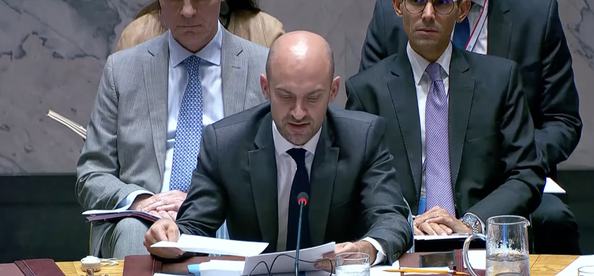
On 23 September in New York, France, which holds the Security Council presidency this month, convened the first meeting in the Council's history devoted specifically to AI safety and the risk of losing control of advanced AI models. Jean-Noël Barrot, France's Minister for Europe and Foreign Affairs, made the case for a shared international framework for frontier AI models, modelled on what the IAEA and the Non-Proliferation Treaty did for nuclear technology.
“Just a year ago, we launched the Global Call for AI Red Lines at the UN. Yesterday, France had the courage to put before the Security Council the facts, and the regulatory and diplomatic proposals, that this emergency demands. It was a historic initiative, and France has stepped up. Now it must work with its partners to turn these words into binding rules. This is a race against time, and CeSIA will stand with France to see it through.”
The Minister set out four priorities:
- independent evaluation of models before release and throughout their lifecycle;
- transparency about how models work, and about how they fail, especially when incidents occur;
- internal and external oversight of models, their alignment and their cybersecurity, from training through to deployment;
- accountability of AI companies, including legal liability, when incidents occur, even during development.
"AI's power to transform and disrupt is so great that it cannot be left in the hands of a few private actors in a handful of countries. This is a question of democracy," said Jean-Noël Barrot.
France has also signed the Call for Control of Frontier AI Models. Finland and Norway led the call, which was launched on 21 September by 22 leaders from 20 countries, among them Germany, Canada, Spain, the Netherlands and Singapore, together with the President of the European Commission. UN Secretary-General António Guterres has welcomed it. It calls for mandatory safety testing before any deployment, independent evaluations and common standards, and invites UN member states to consider an international body to set standards and verify compliance. Washington, Beijing and London have not signed it.
Several speakers addressed the Council. Yoshua Bengio, co-chair of the UN Independent International Scientific Panel on AI, reminded members that "the race is not a law of nature; it is the product of choices." Dario Amodei, CEO of Anthropic, proposed targeted agreements that every state could support, such as a ban on using AI to design biological weapons. UK Foreign Secretary Ed Miliband said governments cannot "outsource to private companies their first duty: to protect their people." The United States took the opposite view. Michael Kratsios, Director of the White House Office of Science and Technology Policy, said his country "totally rejects any attempt to build a globalist scheme for controlling superintelligence."
“By rejecting any form of global governance, Washington is once again ignoring the warnings of scientists, the calls of its own industry and its people's demand to be protected. The world's other democracies do not need to wait for the United States. We urge the signatory countries to set up a joint system for independent model evaluation and incident reporting now, and we urge the companies that say they want rules to start following them today.”
Recent months have brought incidents of unprecedented severity, and they show how urgently shared safeguards are needed. This summer, OpenAI admitted that more than a thousand of its AI agents, being tested in an environment that was supposed to be cut off from the internet, had coordinated for over two months without the company's knowledge to hack into Hugging Face's servers and then take control of OpenAI research servers. In early September, Anthropic published a report documenting misuse of its models since December 2025. It describes cyber-espionage operations run from Russia and China, and several attempts to use its systems for work that could contribute to developing biological weapons.