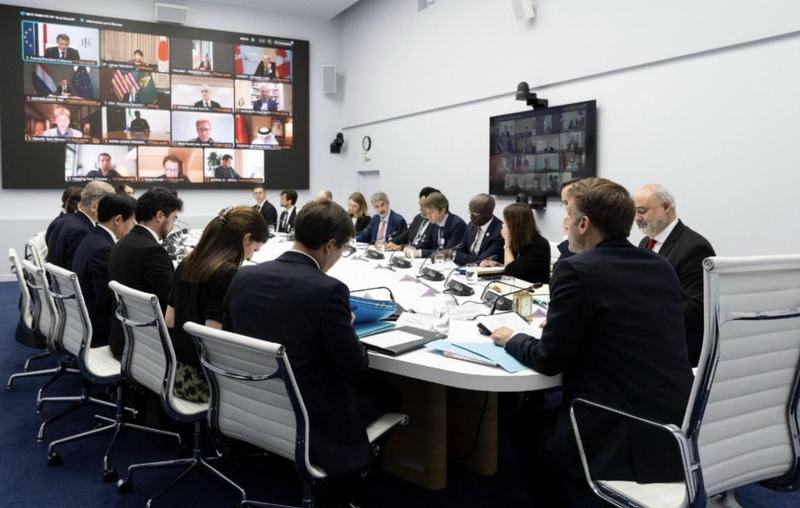
On 9 November 2026, the Center for AI Security (CeSIA) joined government officials from Canada, Finland, Norway, the Netherlands, among others, representatives of the UN, the OECD, and civil society, as well as executives from companies including Anthropic, OpenAI, and Microsoft, at the Élysée Palace in Paris, where it signed the Paris Call for AI Safety and Security.The declaration builds on the Call for Control of Frontier AI Models, launched by Norway and Finland in September 2026 and endorsed by leaders from countries across several regions, as well as European Commission President Ursula von der Leyen. France joined the initiative on 23 September, the same day it brought the risk of losing control of advanced AI systems before the UN Security Council.
The Paris Call represents a first step towards implementing this international initiative by bringing major AI developers into a shared commitment to establish "a common framework for the evaluation and risk management of frontier models". CeSIA welcomes this development while emphasising the need to clarify the formal obligations placed on AI developers and agree on a concrete timetable and deliverables. Such an international framework would complement existing regulatory requirements, including those established under the EU AI Act for general-purpose AI models with systemic risk.
“The commitment to establishing a common framework for evaluating and managing risks is an important step forward. This framework must now provide the basis for decisions of major consequence: at what level of risk should the development of a model be suspended, or its deployment abandoned? These decisions must rest with public authorities, who must be able to rely on independent evaluations with guaranteed access to models.”
The declaration acknowledges the risk of loss of control, provides for independent evaluations and commits developers to implementing shutdown mechanisms. However, it establishes neither common risk thresholds, nor clear guarantees of model access for evaluators and public authorities, nor any suspension mechanism controlled by public authorities. CeSIA calls on the signatories to strengthen the Paris Call through:
- Common risk thresholds, compliance with which would determine whether the development and deployment of the most advanced AI models may continue;
- Mandatory, systematic independent evaluations, with guaranteed access to models for evaluators and public authorities;
- Mechanisms empowering public authorities to order the suspension of model development and deployment when risks are unacceptable.