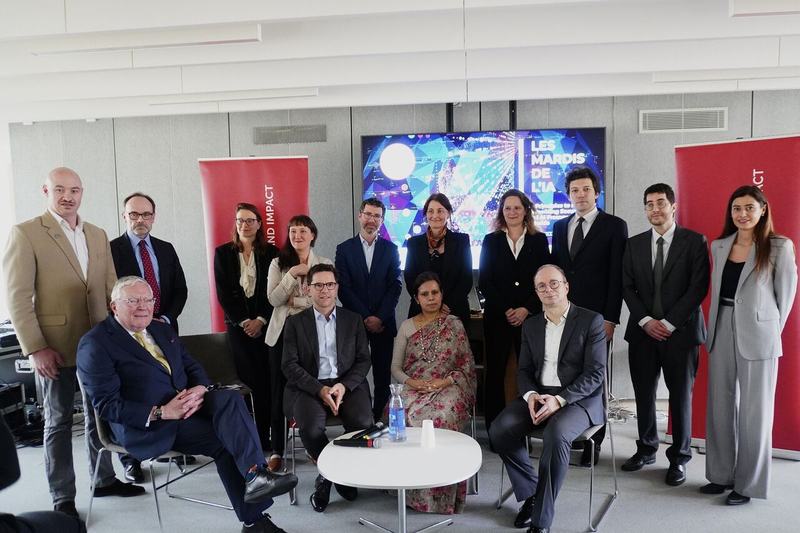
Le Centre pour la Sécurité de l'IA (CeSIA) and Sciences Po hosted the G7-labelled conference "From Principles to Practice: Implementing Safe and Ethical AI Frameworks at a Global Scale", as part of the Les Mardis de l'IA initiative. Held on 10 March 2026 at Sciences Po Paris, this high-level event brought together 135 registered participants and 12 international speakers — policymakers, diplomats, and AI experts from France, the United Kingdom, Switzerland, Canada, India, and the European Union.
As a G7-labelled event, the conference served as a bridge between the 2026 Delhi AI Impact Summit and the 2027 Geneva edition.
Discussions centred on good practices, cross-border cooperation, and concrete policy recommendations for governments, industry, and civil society. The French G7 presidency was seen as a critical window of opportunity for building international consensus on AI safety.
In taking stock of the series of global AI summits — from Bletchley to Delhi, and soon Geneva — participants broadly converged on a shared finding: while awareness of AI safety, inclusivity, and governance challenges is genuine, the shift from voluntary principles to binding frameworks remains a major challenge.
Initiatives such as the Global Call for AI Red Lines and the OECD Hiroshima AI Process were cited as essential for sustaining political momentum and ensuring accountability mechanisms. The UN Global Dialogue on AI, scheduled in Switzerland in July 2026, and the 2027 Geneva Summit offer an opportunity to anchor human rights and humanitarian principles in AI governance, drawing on the spirit of the Geneva Conventions.
The European Union's risk-based approach — built on transparency and international standards — was also commended as a model for reconciling innovation with regulation. The conference ultimately confirmed that ethical AI demands governance that is both concrete and collaborative: institutionalising dialogue, adapting standards as technology evolves, and remaining vigilant in the face of emerging risks.
Conference Programme — March 10, 2026
Welcome at the Sciences Po Innovation Pavilion & Group photo with speakers
5:00 PM – 5:10 PM | Welcome address Prof. Natacha Valla, Dean, Sciences Po School of Management and Impact
5:10 PM – 5:20 PM | Opening remarks Prof. Yoshua Bengio, co-chair of the UN International Scientific Panel on AI, 2018 Turing Award laureate, and founder of MILA Introduced by Charbel-Raphael Segerie, Executive Director, CeSIA & Expert to the OECD AI Group
5:20 PM – 6:30 PM | High-level panel (including 10 min Q&A)
- Lord Tim Clement-Jones, Member of the House of Lords and co-chair of the UK All-Party Parliamentary Group on AI
- Dr. Justin Vaïsse, founder and CEO of the Paris Peace Forum [Moderator]
- Eenam Gambhir, Minister-Counsellor at the Embassy of India in France
- Miriam Minder, co-head of Digital and New Technologies, Swiss Federal Department of Foreign Affairs
- Nicolas Miailhe, co-founder, AI Safety Connect & Expert to the OECD AI Group
6:30 PM – 6:40 PM | Keynote — The European Union in action: turning AI principles into practice Dr. Juha Heikkilä, AI Adviser to the Director-General of the European Commission's AI Office
6:40 PM – 7:15 PM | Fireside chat (including 10 min Q&A) Prof. Alexei Grinbaum, chair of the CEA Digital Ethics Committee Moderated by Alexandre Mirlesse, AI/Tech diplomat, Ministry for Europe and Foreign Affairs, AI Envoy (Africa Forward Summit 2026)
Closing remarks and acknowledgements by Pauline Charazac, Head of Policy Engagement, CeSIA